
The Casualties of the Trans-Atlantic Slave Trade
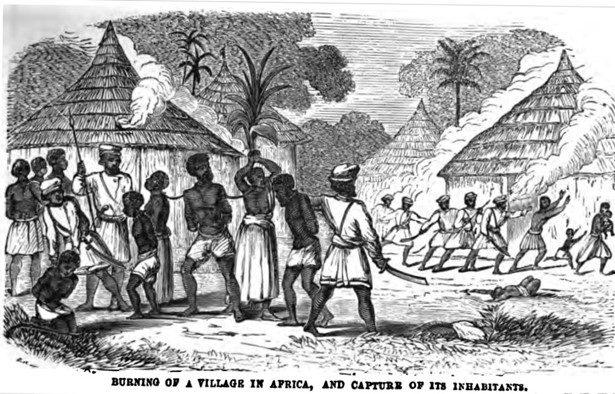
| Wesleyan Juvenile Offering. 1859. Burning of a Village in Africa, and Capture of its Inhabitants (p.12, February 1859, XVI) |
In the modern era, society continually reminds us of genocidal policies and acts that have occurred because they represent a devastating blow to our enduring human aspiration to live in the image of a benevolent creator. However, the genocide that took place on the African continent during the Slave Trade in this same era remains obscure, although it is the most horrific genocide to have occurred in the modern era, which began the trend of unchecked annihilation of the human family.
The magnitude of the genocide associated with the slave trade was revealed in the late 18th century by the British abolitionist and Parliamentarian Sir William Wilberforce. In his 1789 speech to Parliament, he details the total mortality rate of Africans during the Middle Passage to be 12.5%; One to two weeks before the sale, 4.5% died; and during seasoning, 33% of the remaining African victims died. Overall, Wilberforce estimates a 50% mortality rate.[1]
While Wilberforce’s analysis does not deal with the mortality rate of Africans on the continent, author Thomas Fowell Buxton, a British Parliamentarian, wrote of the overall casualty rate in his 1839 book The African Slave Trade and Its Remedy.[2] Buxton is careful to attribute the causes of the wars occurring in Africa to European demand for slaves. He gives first-hand accounts of slave raids where the slave traders killed the old and captured the young. He describes a cycle of attacks on towns followed by brutal retribution.[3] These eyewitness accounts shed some light on the overall number of people killed during the wars against African people.
Thomas Cooper, a contemporary of Thomas Jefferson, is listed as the source of the estimates of 10 deaths on African soil for each survivor; he further lists a 20% casualty rate during the Middle Passage; and a 33% casualty rate during seasoning in the New World. Using Cooper’s calculations, scholars estimate that 180 million Africans perished due to the slave trade. [4] (See note below on historian, Seymour Drescher)
Additional work was done in the 20th century by African American scholar W.E.B. Dubois who continued collecting data of ship’s logs in conducting his study. Later, the United Nations Population Fund (UNPF) did a study of the effects of the slave trade on Africa’s population. The analyses show that in 1600, Africa’s population was approximately 114 million. In that year, it compares proportionally to the populations of Europe and Asia. However, by 1900 Europe’s population was 268 percent larger, and Asia grew by 179 percent. However, Africa’s population growth stagnated.
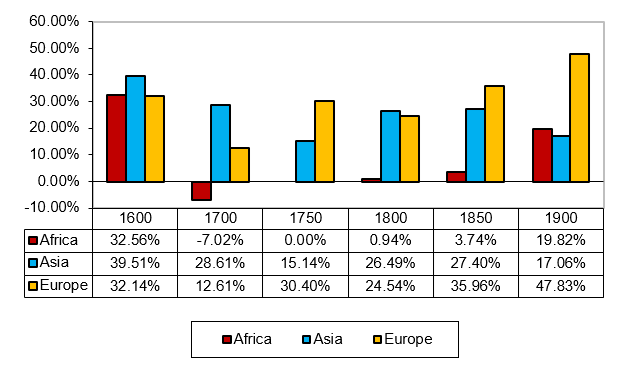
In contrast to the expected population increases in Europe and Asia, Africa’s population growth was 16.67 percent. Furthermore, from 1700 up to the point that the wars for slavery had ended late in the 19th century, Africa’s population growth remained below its original level attained in 1600. In fact, in 1700, the African population growth rate was a negative 7.0 percent. (see chart below)
Table 1: Comparison of Population Growth in Africa, Asia, and Europe (1600 and 1900)
| Population (in millions) | Gain in population (in percent) | ||
| 1600 | 1900 | ||
| Asia | 339 | 947 | 179.35 |
| Europe | 111 | 408 | 267.57 |
| Africa | 114 | 133 | 16.67 |
Figure 1: Comparison of Population Growth Rate by Region (YOY in percent)
Notes:
[1] William Wilberforce’s 1789 Abolition Speech. From ‘Debate on Mr. Wilberforce’s Resolutions respecting the Slave Trade’ in William Cobbett, The Parliamentary History of England. From the Norman Conquest in 1066 to the year 1803, 36 vols (London: T. Curson Hansard, 1806-1820), 28 (1789-91), cols 42-68.
[2] Buxton, The African Slave Trade and Its Remedy (London, 1967; orig. pub. 1839, 1840), 73.
[3] Buxton, The African Slave Trade and Its Remedy (London, 1967; orig. pub. 1839, 1840), 61–62.
[4] Herbert S. Klein, Stanley L. Engerman, Robin Haines, and Ralph Shlomowitz. Transoceanic Mortality: The Slave Trade in Comparative Perspective, p. 19. Based on (Thomas Cooper, Supplement to Mr. Cooper’s Letter on the Slave Trade (Manchester, 1788), 3, 4.)
Note from Transoceanic Mortality: The Slave Trade in Comparative Perspective
Herbert S. Klein, Stanley L. Engerman, Robin Haines, and Ralph Shlomowitz. Transoceanic Mortality: The Slave Trade in Comparative Perspective, p. 19. Based on (Thomas Cooper, Supplement to Mr. Cooper’s Letter on the Slave Trade (Manchester, 1788), 3, 4.)
Speech of Mr. Wilberforce, Hansard, 28 (1789-1791), (London, 1816), 41-67 (quotation on 47). A similar point was made in one of the most influential of anti-slave trade pamphlets. James Ramsay, Objections to the Abolition of the Slave Trade, with Answers (Miami, 1969; orig. pub. 1788, 2 d ed., 1788), 71, argued that even if shipboard mortality was 5% in ordinary cases, somewhere between 1/10 and 1/2 of all slaves arriving came with diseases, and only 1/3 of these survived seasoning. Thus he attributes 2/3 of seasoning deaths to voyage conditions, meaning that “the loss of one-fourth part, or perhaps a third of the whole, may be charged to the voyage.” This would mean, however, that between 1/7 and 2/5 of deaths after boarding ships in Africa occurred on the Middle Passage. Seymour Drescher, in correspondence with the authors, points out estimates made by Thomas Cooper, Supplement to Mr. Cooper’s Letter on the Slave Trade (Manchester, 1788), 3, 4, who argued that, for each slave taken, 10 were lost due to warfare in Africa, 1/5 died in passage, and another 1/3 died during seasoning. Using estimates of slaves arrived during the period of the slave trade, the 10 million slaves arrived in the New World meant a cost of 180 million lives. This would mean that Middle Passage deaths were equal to about 2% of all the deaths attributed to the slave trade. In making his estimates in this and in subsequent presentations of the same numbers, Cooper drew on the work of numerous contemporaries, including Thomas Clarkson, An Essay on the Slavery and Commerce of the Human Species, particularly the African (Dublin, 1786).
