
The Sahel’s Exit from Fiat: Hard Money & Digital Sovereignty
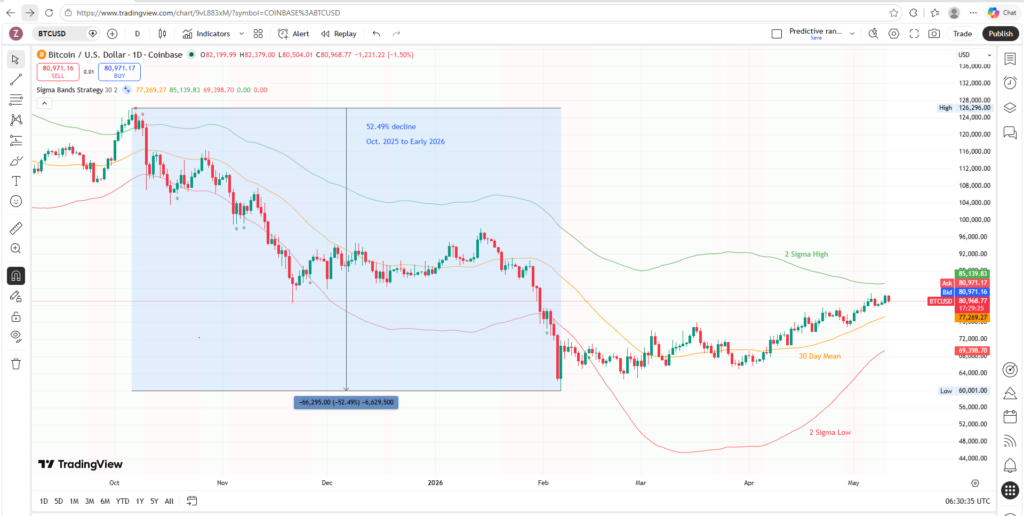
The Sovereign Entry Zone: Using my Sigma Bands Strategy to identify the mathematical floor ($77,269) where hard-money reserves are built during institutional volatility. (See Financial Disclaimer)
The Death of the London Banker Note
The world is witnessing a return to the hard money principles that were abandoned in 1971 by President Nixon. Historically, the removal of the gold peg to the US dollar was a slow drip of sound money, which has accelerated into an irreversible torrent of fiat printing. The empire-killing practice left its traces in ancient Rome, where Roman Emperors clipped bits off Roman coins while retaining their original value. The same practice of debasing the currency is traced to the underhanded activities of London goldsmiths and bankers who kept the public’s gold for safekeeping. They soon realized they could easily print more banknotes than they had gold in their vaults—a practice widely documented as the origin of fractional reserve banking.
While the West’s transition to an unbacked currency supported by a nation’s economic output or promise to pay was a more transparent model, modern nations now stubbornly cling to the hidden, inflationary effects of fiat money. As the Western world falls deeper into the debt trap fueled by runaway money printing, the Alliance of Sahel States (AES) is looking toward a future in which value is tied to real production of hard assets rather than promises. This is not just a national pivot but is a Confederal Strategy to replace dwindling promises with tangible resources. That same thrust resounds globally as buyers seek relief in Bitcoin.
AES Government’s Strategy is the Reclamation of its Mineral Wealth (Hard Money)
The AES has developed a reclamation methodology to safeguard its vital national interests. Mali has nationalized the foreign‑owned SOMIFI and halted mining conventions deemed exploitative. Burkina Faso now requires 15% state ownership in industrial mines and has created a national gold reserve. Niger has seized Orano’s uranium operations, where 1,500–1,570 tons of uranium are stored. Niger is now pursuing a lawsuit against the French company for environmental damage, accusing it of leaving hundreds of barrels of radioactive waste and contaminating local land and water resources.
Together, the coordinated AES efforts are meant to ensure that mineral wealth benefits local populations, curb foreign dominance, and advance a broader agenda of economic sovereignty.
The 20% Retention Crisis (The “Leaky Bucket”)
According to African Development Bank data, Africa’s raw mineral exports generate roughly $400 billion annually. However, when viewed through the lens of the global value chain—where OECD and World Bank analyses show African nations retain less than 20% of the wealth generated—the total economic output of these resources is a staggering $2 Trillion. This $1.6 Trillion leakage is the true cost of the London Banker model.
The current system is a leaky bucket. While the AES produces the gold, uranium, and lithium the world craves, OECD and World Bank analyses confirm a sobering reality. By moving to a resource-backed confederal currency, the AES isn’t just minting money; they are building a refined financial system that keeps that missing 80% of value within their territory.
The Resource Moat of the Liptako-Gourma Region
The April 25 attack against Mali hides an appalling greed of its neighbors and fair-weather friends who have long had the valiant people of the Sahel states on the menu. But the birth of the AES (formalized in July 2024 and fully operational in 2026) has changed the math.
Underneath the desert sands of this three-nation bloc lies a combined Resource Moat that protects the nations’ control over their critical resources, which include:
- Gold: Mali and Burkina Faso are among Africa’s top producers (Mali alone has 800+ tons of proven reserves).
- Uranium: Niger holds approximately 5% of global production, essential for the world’s nuclear energy future.
- Lithium: Mali is Africa’s second-largest producer in 2026, with the Goulamina project in southern Mali, containing approximately one hundred million tons of battery-grade ore.
- Oil & Manganese: Significant deposits in Niger and Burkina Faso that add industrial teeth to the currency basket.
The Mechanics of a Resource-Backed AES Currency
The AES common currency is not a direct 1:1 gold note. Instead, it utilizes a Commodity Basket Model. By pooling equity from their respective mining codes, the AES creates a collective reserve that is immune to Western central bank constraints. This self-sufficiency rejects the debt-trap. Unlike Zimbabwe, which was forced into compromises while standing alone against the full might of the West, the AES operates as a Tri-State Bloc. Their combined leverage allows them to endure sanctions while building an independent financial architecture—including the AES Investment Bank— designed to reduce dependence on SWIFT.
The Bitcoin Stress Test: Lessons from the 50% Correction
The massive drawdown seen in the image above, between October 2025 and early 2026, represents a –52.49% drop, which was a wake-up call for hard money enthusiasts. It proved that while Bitcoin is hard money, its current adoption by institutional whales has introduced an element of instability. It is highly unlikely that the AES or most states could withstand a 50% drop in the value of their currency. Nevertheless, Bitcoin reached a bottom after sellers were exhausted and did not go to zero, as the image above shows.
The Twin Pillars of Hard Money: Mineral Wealth and Digital Scarcity
While the AES builds its ‘Physical Floor’ on the undeniable value of gold and lithium, the global market is simultaneously seeking a ‘Mathematical Floor’ through assets like Bitcoin, which has its own mathematical limits on debasement. Our analysis showed Bitcoin finding its Sigma Low support near $77,269. For the AES, Bitcoin is not the backing for their currency, but it is a potential trade mechanism that allows the Confederation to move value across borders instantly while its physical gold remains securely as the sovereign anchor of their own currency.
Conclusion: The Birth of a New Era
The numbers don’t lie. While the African Development Bank projects double-digit growth for nations like Niger, the OECD reveals that African nations are still only keeping 20% of their $2 Trillion potential. The $1.6 Trillion gap is the price of their silence. By launching a resource-backed confederal currency, the AES is telling the London Banker that the era of the 80% discount is over. They are moving from being a larder for the world to being the masters of their own value.
By tracking gold and lithium reserves on a blockchain,* the AES creates a Proof-of-Reserve model that enables audited, transparent trade. We are witnessing the birth of a decentralized, resource-backed economic zone. The era of the London Banker is ending; the era of the Sovereign Producer has begun. The public distrust of fiat models is reflected in its support for Bitcoin, which, despite a near-fatal decline, held the line and will prove to be a viable alternative for states seeking freedom from financial manipulation.
Note: Blockchain is a distributed ledger technology that records transactions across multiple computers, ensuring data is secure, transparent, and immutable. Each transaction is recorded as a block of data, which is linked to the previous block, forming a chain of blocks, hence the name “blockchain”.
