
The Sahel’s Awakening: Reporting on a Century of Systemic Injustice
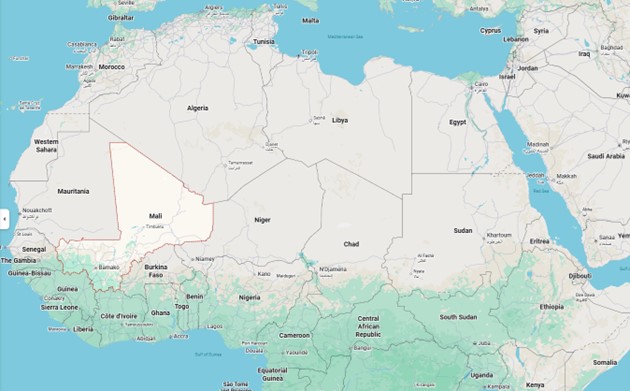
Map of North Africa — Mali
With their currency and economy firmly under French control, Francophone Africa in the Sahel clearly illustrates the machinery of modern imperialist exploitation. After decades of French influence, poverty levels are among the highest in the world. Approximately 60–64 percent of these Alliance of Sahel States (AES) populations live on less than $5.00 per day.
Table 1: Percentage of population living below global poverty lines
| AES States | Region | World Bank Income group -2025 | Poverty headcount ratio (2021 PPP) at | Year | ||
| $3.00 a day | $4.20 a day | $8.0 a day | ||||
| Burkina Faso | Sub-Saharan Africa | Low | 42.10% | 64.60% | 90.40% | 2021 |
| Mali | Sub-Saharan Africa | Low | 36.10% | 59.50% | 88.60% | 2021 |
| Niger | Sub-Saharan Africa | Low | 60.50% | 79.70% | 96.10% | 2021 |
Nevertheless, despite centuries of oppression, a historic pivot toward a common-sense economic policy is underway. Recent macroeconomic reports project robust growth for the AES states in 2026, even as security shocks and humanitarian needs remain significant. The nations of Mali, Niger, and Burkina Faso have begun dismantling the French security framework and the coercive caste system. These systems have left Sahelian populations impoverished and have provided a steady flow of young recruits whose efforts support their handlers’ exploitation of the region’s resources through illicit gold mining operations.
On April 25, 2026, the Russian Africa Corp cited ten to twelve thousand combined forces of an Al-Qaeda offshoot, rebranded as JNIM, and the Tuareg separatists known as the Azawad Liberation Front (FLA) that attacked Mali. There were also internal Malian participants, both military and political, who were arrested by Malian authorities and charged by the Malian prosecutor’s office with collaborating with the terrorists. The attack that analysts define as a decapitation strike killed the Defense Minister, Sadio Camara, his second wife, and two grandchildren at their home. The president, Assimi Goita, sheltered in an undisclosed location.
According to the African Corps, the invaders reportedly entered Mali via Mauritania. They were photographed crossing the border at various times and entering a hidden camp under drone surveillance. Additionally, the Malian Prime Minister, standing before a large audience of Malians and foreign officials and correspondents, accused France and Algeria of backing the terrorist groups in the Sahel. The terrorists struck 5 cities, Bamako, Kati, Gao, Sevare, and Kidal, simultaneously.
In the Sahel, Mauritania is cited as the last country to formally abolish slavery in 1981 and to criminalize it in 2007, yet de facto slavery remains a severe issue. Algeria, on the other hand, is recognized by analysts for its decades-long collusion with France, Mali’s avowed Francophone partner, including tapping Mali’s oil reserves and splitting the profits with France. To date, Mali’s oil- and mineral-rich northern region remains inaccessible because of the ensuing violence and instability.
The Myth of Azawad and Minority Influence
After the April 25 invasion, mainstream Western press outlets were flooded with reports about the fall of Kidal, which is regarded as the capital of the separatists’ homeland. However, as an independent observer, I find that the data tells a different story. The separatist movement in the north is numerically insignificant; the Tuareg people constitute approximately 3.5% of Mali’s 22 million people, and many are integrated into the national fabric. They see themselves as Malian despite the caste system that has declared otherwise.
By framing this as a grand ethnic struggle for the Tuareg homeland of Azawad, Western propaganda obscures the fact that a tiny minority is being weaponized to justify the 50/50 partition of a sovereign state nearly twice the size of Texas. The hierarchy, rooted in the traditional Arab caste system that historically suppressed the Black African majority, cannot survive under a unified Malian authority that prioritizes national sovereignty over the defunct, colonial-era caste system. That posture poses a dire threat to the status quo.
The testimonies of a former Tuareg rebel and a former prime Minister of Mali suggest that the instability in the North has been managed rather than fought. The narrative from the Tuareg rebel spokesperson indicates that the fervor for a separate state began when France offered Northern Mali to Libya’s Tuareg fighters in exchange for betraying Gaddafi. After Gaddafi was killed in 2011, armed Tuaregs entered Mali in January 2012 to wage war. They seized the northern territory from Timbuktu to Kidal because France, fresh from its NATO-led attack on Libya, refused to arm Malian soldiers to defend themselves.
Neutralizing the Tactical Sanctuaries
Algeria has served as a controller of Malian aspirations since its independence in 1958, in collusion with French interests. When insurgent groups face pressure from the FAMa (Malian Armed Forces), they frequently retreat across the Algerian border for medical care and resupply. In 2026, Algeria also shot down a Malian drone operating within Malian territory, surveilling a separatist gathering.
Considering Mali’s long history of treachery by France and neighboring countries, can the nation afford to ignore this latest injustice? To safeguard its population and government, in effect, to remove itself from the menu, Mali’s geopolitical response must be absolute. Sealing the 854-mile frontier with Algeria, the alleged transit point of separatist FLA forces that occupy both sides of the border, is a practical necessity to exclude destabilizing elements and end the cycle of tactical retreats. Additionally, halting the proposed highway, rail, and pipeline projects linking Mali to Algiers is another necessary and vital step in halting the centuries of siphoning of its resources. Finally, more directly, the replacement of the CFA Franc’s influence is underway as the only path to a self-sustaining economy.
In dealing with Mauritania’s border infractions, Mali has the right to pursue terrorists into their last hideouts inside Mauritania. The problem of Mauritanians crossing the border and settling in Mali is also problematic, as these populations claim their new homes as Mauritanian territory.
A Self-Sustaining Economy
Table 2: AES Real GDP Growth (2023–2025)
| AES States | 2023 (Actual) | 2024 (Actual/Est.) | 2025 (Estimated) | Primary Drivers |
| Niger | 2.60% | 8.30% | 7.00% | Oil export expansion via the Niger-Benin pipeline; agricultural rebound. |
| Burkina Faso | 3.00% | 4.80% | 5.30% | Gold production; expansion in services and trade. |
| Mali | 4.70% | 4.70% | 4.1% – 5.0% | Mining (lithium and gold); resilience in cereal and cotton harvests. |
With the AES’s initial initiatives towards self-sufficiency, the results are meteoric. Despite the dire warnings from Western financial institutions, the AES is proving that domestic reinvestment works. By securing their natural resource revenues through direct investment in mining operations, developing agriculture, and pursuing industrialization, these nations are finally reaping their own profits.
The surge in GDP we are seeing isn’t a fluke. It is the result of a population that is finally free to jump-start its own economy. My report indicates that the era of Western directives is ending. From the mines of the interior to the borders of Mauritania, a new map is being drawn, in which the Sahel is no longer a playground for foreign security directives, but a sovereign engine of growth.
